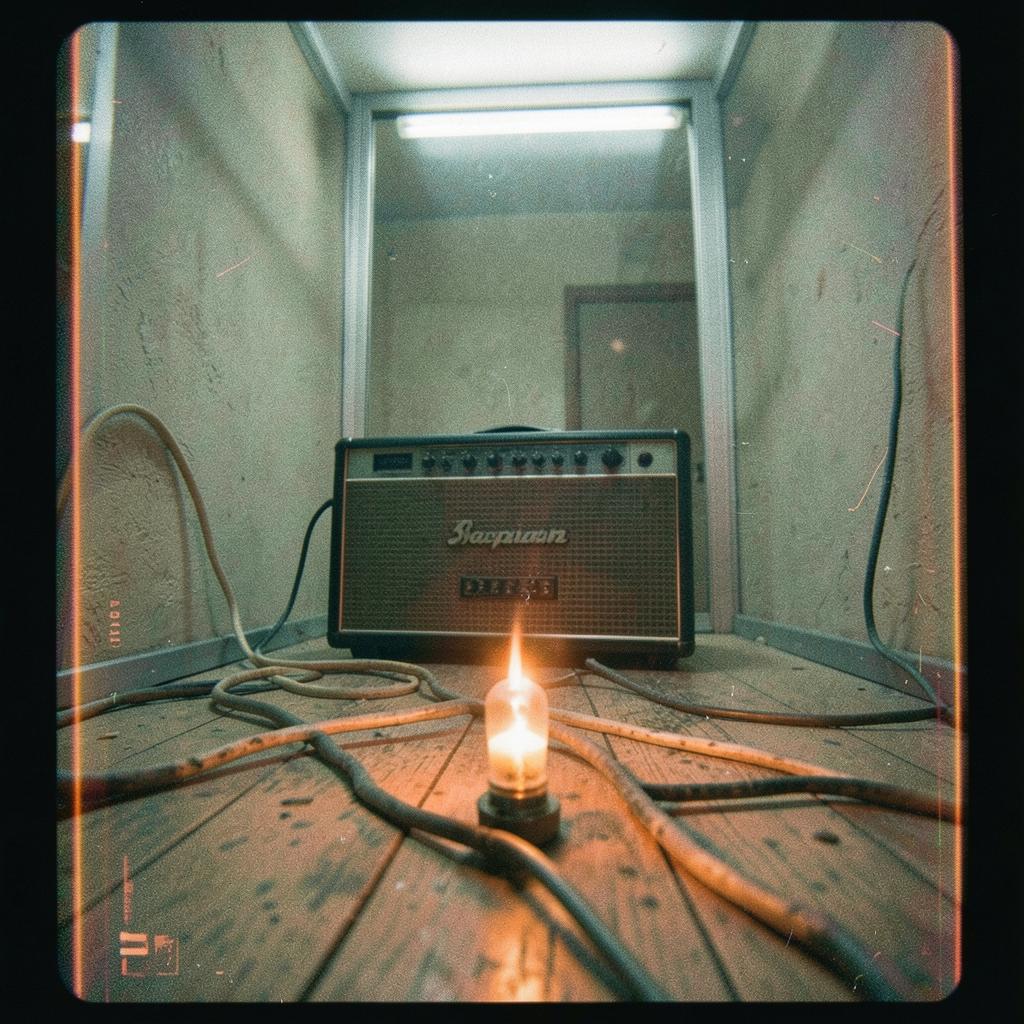

[INTRO — CLOSE-MIC ROOM TONE] [dead-small rehearsal room] [one sustained bowed violin note, rosin and string noise audible] [Marshall valve amp idling at edge of breakup] [amp hum underneath] [no reverb] One room, one voice, one fuse— [VERSE 1 — RESTRAINED, DOCUMENTARY] [drums enter quietly] [dry electric guitar] [round electric bass] [loose human microtiming] [close-mic male vocal, conversational singing] I play the Marshall the way you play a person you've already decided can't hear you: which is to say, for the record, for the transcript—Side A— for the version of the event that will later be admissible. [small instrumental gap] [violin enters as sparse counterline] Exhibit 1 The booth was glass and the glass was— [hard stop] One room. [FOOTNOTE 1 — INTIMATE INTERRUPTION] [instruments nearly disappear] [voice extremely close] [room tone and amplifier hum remain] Actually "fuse" is doing a lot of work here and I'm not sure I've earned it... A fuse is sacrificial— It's the component that dies so the rest of the system doesn't have to, Whereas a circuit breaker— which is what's actually in the phone booth, insofar as any phone booths still exist— just trips, resets... ...asks to be forgiven. So whether the love in question was a fuse-type love or a breaker-type love is maybe the whole question, and I'd like to pretend I'm getting to it organically, but I'm already over two hundred words deep in the weeds of a technical distinction because technical distinctions are easier than saying anything real... [1a — BARELY ABOVE A CONFESSION] [no instruments] See. See what I did there— Put "authenticity" in the smallest available font. It's a lifelong habit and I've been told it's a defense mechanism, which 's what people say when they want you to stop doing it, and I do want to stop, but the habit is the only part of me that's ever told the truth on time, and I fear now that I don't know how to want anything else. [VERSE 2 — BAND RETURNS UNEVENLY] [guitar and violin occupy conflicting rhythms] [bass slightly ahead of drums] [drums remain dry and physical] [occasional natural amplifier feedback] "For the record" is a phrase I've never once said without hearing it as a lie. What record. Kept by whom. The stack keeps nothing. That's maybe the appeal. A wall of speakers is the only teacher I've found that doesn't edit its notes. Which is to say—it posts no notes. Which is to say—it's a wall. [BUILD — VIOLIN MEETS AMPLIFIER] [bow pressure increases] [guitar harmonics begin to ring] [short physical feedback] [band continues underneath] I can't finish the line because "wrong" is what I want, and wrong is not a thing a booth can be. That's maybe the problem with the whole song. I keep assigning moral properties to acoustical phenomena because you never look directly at the acoustical phenomena, which are: I am in a booth. I am making sound. The sound is returning, But there is no person at the other end of it. There is no other end to come back for... That's really the entire problem. A feedback loop is the sound of a signal discovering it's alone— and trying to have a conversation about it anyway. [FINAL SECTION — STRIPPED DOWN] [drums stop] [bass stops] [guitar stops] [one dry violin note] [Marshall hum] [voice extremely close] [leave long spaces] The hum goes on. That's the actual line. That's the line I've been trying to reach for however many words now. The hum goes on. It isn't a metaphor. [violin stops] [amp remains powered] [transformer hum and speaker hiss] [no final chord] The hum goes on. It isn't a metaphor. The hum goes on. The hum's phonons.
